.png)
Can Abacus and Mental Arithmetic Help Children with Dyslexia?
- May 18
- 5 min read

Over the past few years, there has been a meaningful addition in the types of families seeking abacus and mental arithmetic classes. Alongside parents looking to give their children an academic edge, there is a growing number of parents whose children are diagnosed with dyslexia. These children are bright and curious kids who are struggling not because they lack intelligence, but because their brains are wired differently. Their parents are searching, often desperately, for tools which can help their children build confidence, sharpen focus and keep up in a classroom environment that is not always designed with them in mind.
According to researchers and educators, abacus and mental arithmetic can make a positive difference for children with dyslexia. This article examines how, why and what kind of timeline parents can realistically expect.
Understanding the Challenge
Dyslexia is a neurological learning difference that primarily affects the way the brain processes written language. Children with dyslexia often struggle with reading, spelling and sequencing. In fact, their difficulties frequently extend beyond the page. Many experience challenges with working memory, attention and processing speed. In a school setting, this can make it difficult to follow multi-step instructions, stay focused during lessons and complete tasks that require sustained mental effort.
What dyslexia is not is a reflection of a child's intelligence or potential. Many children with dyslexia are highly creative, perceptive and capable of remarkable things when they are given the right tools and environment in which to thrive.
Why Abacus and Mental Arithmetic Work

The abacus is one of the oldest calculating tools in human history, and there is good reason it has endured. Learning to use an abacus, and eventually visualising it mentally in the mind, engages the brain in a uniquely holistic way. Here is what makes it particularly well-suited to children with dyslexia:
1. It is visual and tactile, not text-dependent
One of the most significant advantages of learning abacus is that it bypasses written language almost entirely. A child does not need to decode words or letters to work with an abacus. Instead, he/she engages with concrete, visual representations of numbers using their hands and eyes. For a child who has spent much of their school life struggling with text-based learning, this can be a revelatory and deeply affirming experience.
2. It builds working memory
Mental arithmetic, which is the practice of performing calculations in the mind by visualising the image of an abacus, is, at its core, a working memory exercise. Children are trained to hold a mental image, manipulate it and produce a result. Research consistently shows that targeted working memory training can improve attention span and cognitive control, both of which are areas where children with dyslexia often need support.
3. It develops focus and concentration
Learning abacus and mental arithmetic demands a special kind of quiet, sustained attention. A child cannot rush through a mental arithmetic exercise. Instead, they must slow down, visualise each step and maintain concentration from start to finish. Practised regularly, this trains the brain to focus in a way that carries over into other areas of life, including the classroom and beyond.
4. It builds confidence through measurable success
Children with dyslexia often arrive with an internalised belief that they are “bad at learning”. Learning abacus and mental arithmetic gives them a domain where they can succeed quickly and visibly. Witnessing a child realise they can calculate faster than their peers without the use of a calculator is frequently described by experienced abacus and mental arithmetic teachers as one of the most powerful moments in their classrooms. That confidence is not superficial. In fact, it reshapes how a child approaches challenges across every subject.
5. It engages both hemispheres of the brain
Mental arithmetic using a visualised abacus in the brain activates both the logical left hemisphere and the spatial, creative right hemisphere. This bilateral engagement strengthens neural connections and improve overall cognitive flexibility. This benefits all learners, and particularly those whose brains already process information in non-linear ways.
How Long Until Results Show?
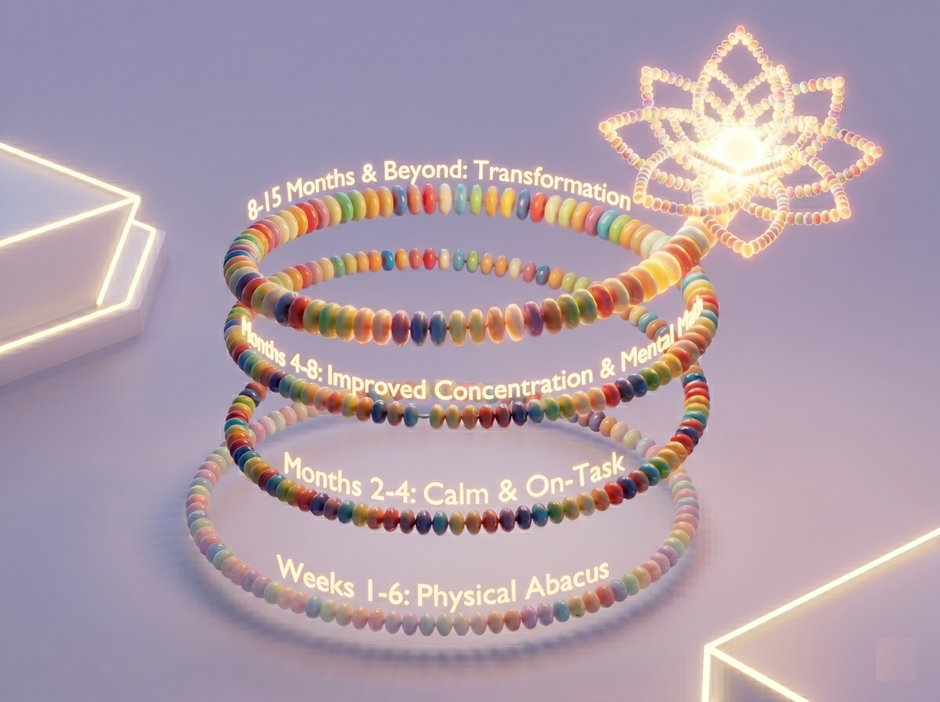
Based on observations from experienced abacus and mental arithmetic teachers working with children who have dyslexia, here is a general timeline for students who attend regular weekly (or twice a week) classes and practise consistently at home for 15 to 20 minutes daily:
Weeks 1 to 6
The child becomes comfortable with the physical abacus. This settling-in period is important and should not be rushed. Many children with dyslexia initially resist new learning environments, so building trust and routine is the priority during this phase.
Months 2 to 4
Parents often report that their child seems calmer and more able to remain on task for longer periods. Classroom teachers may comment that the child appears more focused. These early signs are encouraging, though the child may not yet be aware of the change themselves.
Months 4 to 8
By this stage, children are typically getting the hang of consistent mental arithmetic practice. The cognitive demands increase, and so does the reward. Most children show measurable improvement in concentration, number sense and self-regulation. Many parents notice their child approaching homework with noticeably less resistance.
8 to 15 months and beyond
This is where the most significant transformation tends to occur. Children who have committed to regular practice develop a strong mental arithmetic foundation and, more importantly, a fundamentally different relationship with learning. They become more patient, more persistent and more willing to attempt tasks that they used to feel overwhelming.
It must be emphasised that consistency matters far more than intensity. One or two focused lessons per week, combined with short daily practice of 15 to 20 minutes at home, will yield far better results than sporadic bursts of effort.
A Note for Parents
For parents of children with dyslexia, it is worth reframing what the goal of abacus and mental arithmetic actually is. The aim is not to “fix” a child, because there is nothing broken. Rather, it is to provide a powerful, joyful, text-free learning space where a child's brain can grow stronger and where they can discover, perhaps for the first time, just how capable they truly are.
Experienced abacus and mental arithmetic trainers have observed children arrive in class defeated and leave transformed. This is not because abacus learning is magic, but because it meets children where they are and builds them steadily from there. For parents considering this path, the recommendation from those who have witnessed it first-hand is clear: commit to it and stay consistent for at least a year. The results will speak for themselves.
How Mentalmatics Can Help
At Mentalmatics, our programme is particularly well-suited to children with dyslexia precisely because it is text-free. Learning is built around visual and tactile engagement with numbers, not words. This allows children with dyslexia to experience success in a domain that does not penalise how their brains are wired. Through early, structured whole-brain training, working memory, concentration and cognitive flexibility are all progressively strengthened. The result is not just stronger arithmetic in the child. Instead, we develop a child who progressively triumphs over every learning challenge with greater confidence and resilience.
To find out more, talk to us or register for a trial class using the link below!


Comments