.png)
Can Abacus and Mental Arithmetic Training Really Help Children with ADHD Focus Better?
- Apr 27
- 4 min read

Over the past few years, a steady shift has been noticed in the type of students who are seen entering the classroom. In addition to more parents wanting their children to be quicker at calculations, there is also a group of parents whose children have been diagnosed with ADHD, and they are looking for any structured and engaging activity that can help to sharpen their attention. Many parents regularly ask this question: “Can abacus and mental arithmetic training actually help my child focus?”
The short answer is yes, and the benefits go well beyond just numbers on a bead frame.
Why Children with ADHD Struggle in Traditional Classrooms
Children with ADHD are typically found to experience challenges with sustained attention, impulse control and working memory. A conventional classroom with its passive listening, long reading tasks and delayed feedback loops is not structured in a way that suits how their brains are wired. Novelty, immediate feedback and multi-sensory engagement are what are craved by these children. Sitting still and copying from a whiteboard provides none of those things.
This is precisely where abacus training is seen to offer something different. The abacus does not allow a child to sit passively. Presence is demanded by using the eyes, the fingers and the mind, all at once.
How Abacus & Mental Arithmetic Training Engages the ADHD Brain
Abacus learning is inherently multi-sensory. The beads must be watched, felt as they are moved, and the resulting number must be visualised and held in the mind while the next step is being processed. This simultaneous engagement of visual, tactile and cognitive channels is the core mechanism of the method. Particularly for a child with ADHD, this is considered highly significant.
Research in neurodevelopment has consistently shown that sustained attention is better maintained in children with ADHD when they are engaged in multi-sensory tasks. Because active, immediate input is required at every step of abacus arithmetic, very little opportunity is given for the mind to wander. In a sense, the task itself is doing part of the focusing work.
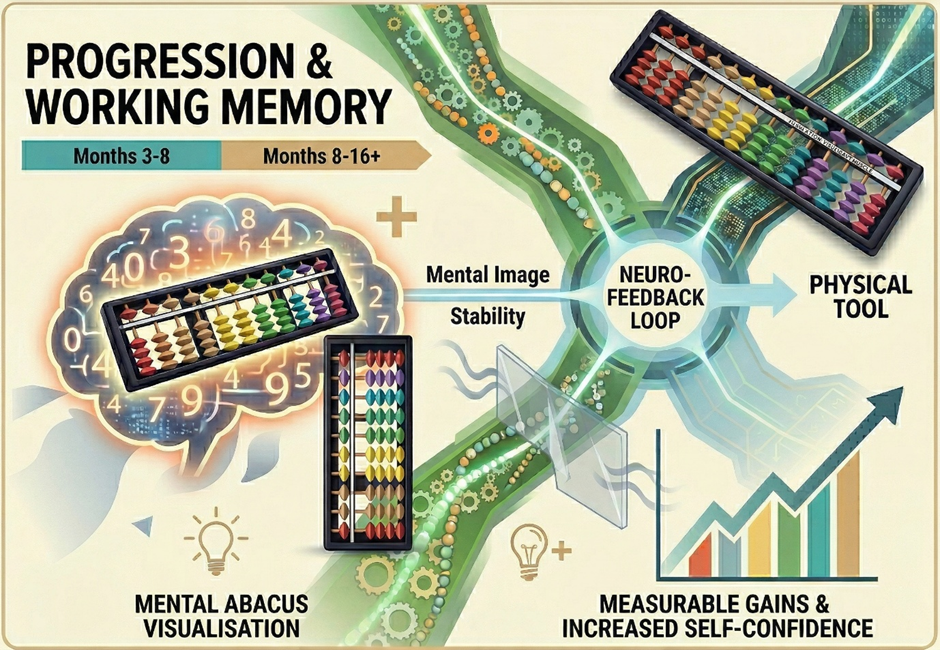
As students are trained in mental arithmetic – where the abacus is visualised in the mind's eye and calculations are performed without the physical abacus – the demands placed on working memory and concentration are increased further. A complete mental image must be held stable while new information is simultaneously processed. For a child with ADHD, this is functions like a structured workout for the very cognitive muscles that are weakened by the condition.
What has Been Observed in Students
Abacus and mental arithmetic training is not a cure, and results are experienced differently child-to-child. However, consistent patterns have been observed that are genuinely encouraging.
Children with ADHD who join classes are often found to be fidgety, easily distracted and quick to give up when a task feels difficult. The abacus, however, captures their attention in a way that surprises even the parents who observe from the sidelines. Something about the tactile, rhythmic nature of moving beads, combined with the visible, immediate result of each move, is found to hold their interest in a way that a worksheet simply cannot.
In addition, the structured, repetitive nature of the drills helps to establish predictability, and many children with ADHD are found to respond to with a sense of calm. Once the routine has been learned, the lesson itself becomes a kind of anchor for them.
How Long Before Results are Seen?

It is important that realistic expectations are set. Abacus and mental arithmetic training is a long-term programme, not a quick fix. The greatest benefits are seen in children who practise regularly, i.e. ideally for 15 to 20 minutes daily at home, in addition to weekly classes. Consistency is found to matter more than intensity. Sporadic attendance will produce sporadic results. Commitment is crucial.
Abacus and mental arithmetic training is most effective when it forms part of a broader support strategy. It is intended to complement, and not replace, any school and therapeutic support or medical guidance that may already be in place for the child.
The Confidence Factor
One outcome that was not fully anticipated when ADHD children were first being taught was how significantly their self-esteem have increased alongside their arithmetic skills. Many of these children arrive carrying a quiet sense of failure which has been attached to them, implicitly or explicitly, through repeated experiences of being told they cannot concentrate, cannot finish things or cannot keep up. When something concrete and measurable is being mastered, e.g. when a four-digit sum is being calculated mentally, faster than a child without ADHD using pen and paper, something is seen to shift in how they view themselves. That shift is observed to carry through into every other part of their school life.
Advice for Parents
If abacus and mental arithmetic training is being considered for a child with ADHD, an open mind and a patient heart are what is called for. Small wins deserve to be celebrated, e.g. the first time a full class is completed without getting up, the first week that practice is maintained every day or the first time a problem is solved mentally that once required fingers and counting.
Progress for a child with ADHD is rarely found to be linear. There will be good weeks and frustrating ones. No ADHD child has yet been encountered who was not capable of remarkable focus if given the right environment, the right task and enough time. The abacus, in the experience of those who teach it, can be exactly that right task.
How Mentalmatics Can Help
At Mentalmatics, early mental arithmetic training is approached as a structured, whole-brain engagement programme. By guiding children to visualise the movements of the abacus beads mentally, the working memory and sustained attention that are so often challenged by ADHD are given a purposeful and consistent workout. Because the brain's plasticity is greatest in early childhood, starting the programme young maximises its impact by building not just arithmetic ability, but the focus and confidence that carry children through their entire school journey.
To find out more, talk to us or register for a trial class using the link below!


Comments